

Customs Bonds Explained: Single Entry vs Continuous, and Which One You Actually Need
If you import goods into the United States at commercial scale, US Customs and Border Protection does not trust your promise to pay duties. It wants a guarantee from a third party — a customs bond. The confusing part is that there are two very different products sold under that name, picking the wrong one wastes money, and the paperwork hides a detail that matters for ocean freight. This article explains what a bond actually is, when the law requires one, and how to choose between a single entry bond and a continuous bond.
What a Customs Bond Actually Is
A customs bond is a contract between three parties: you (the principal), a surety company licensed by the Treasury, and CBP. The bond guarantees that if you fail to pay duties, taxes, or penalties, the surety pays CBP on your behalf — and then comes after you for reimbursement.
That last clause is the one importers misread. A bond is not insurance. Insurance absorbs a loss; a surety extends credit and expects to be repaid. When you sign the bond application, you sign an indemnity agreement. So the bond protects CBP, never you. What it does for you is practical: it lets your entries clear without pre-paying every dollar of duty, and it keeps you compliant.
Bonds also back more than duties. If CBP issues a penalty — say, for a misdeclared classification under 19 CFR 159.2 — the claim goes against the bond too. See what actually happens when your HS code is wrong for how that unfolds.
When a Bond Is Required
The trigger is the formal entry:
- Entries over $2,500 in value require a formal entry, and a formal entry requires a bond.
- Goods regulated by a partner government agency (FDA, FCC, CPSC and others) can require formal entry regardless of value, which means a bond even for small shipments.
- Ocean cargo needs an Importer Security Filing (ISF, the “10+2”), and ISF compliance has its own bond requirement. More on this below.
Below those thresholds, shipments can enter informally or ride the de minimis exemption — but the de minimis landscape has been shifting for e-commerce. See what importers should do now that de minimis is suspended for the current picture.
Single Entry Bond: One Shipment, One Bond
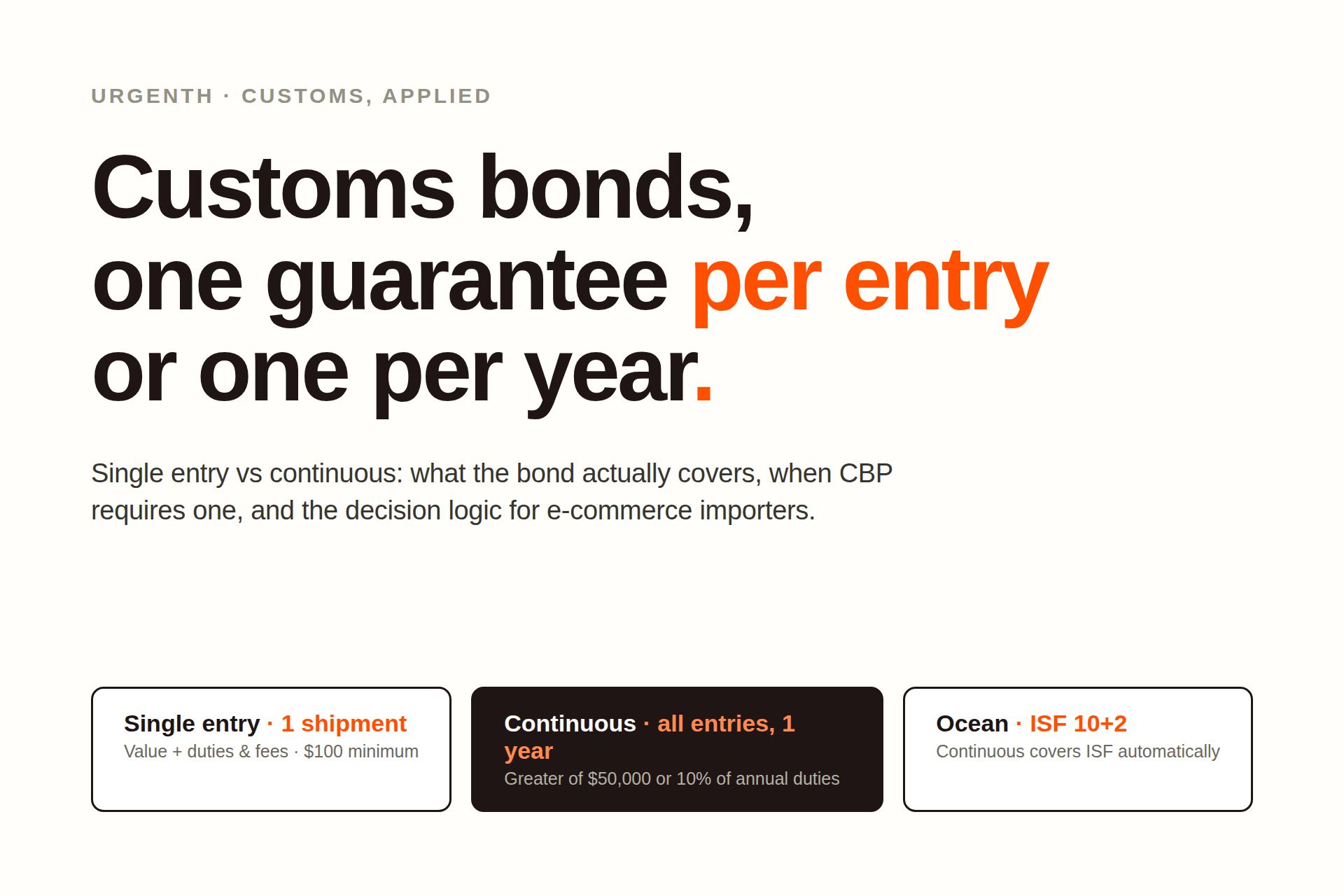
A single entry bond (SEB) covers exactly one customs entry. If you import once a quarter for a project, it does the job with no annual commitment.
The bond amount for an SEB is the entered value of the shipment plus all duties, taxes, and fees, with a minimum of $100. Two things catch importers off guard:
AD/CVD and Section 301 goods inflate the amount. For merchandise covered by anti-dumping or countervailing duty orders, SEB amounts are set at three times the value of the goods, because AD/CVD bills can exceed the invoice several times over. Under CBP guidance, the same elevated sizing has applied to single entry bonds for Section 301-covered goods. If you are importing covered merchandise, check how to look up what tariffs apply to your product before assuming your bond is adequate.
Ocean SEBs need a separate ISF bond. If your shipment moves by sea, an SEB does not cover the Importer Security Filing. You need a standalone ISF bond for that entry, typically $10,000 in coverage, bought alongside the SEB.
What you pay the broker or surety is a premium — a fraction of the bond amount, priced per shipment. Frequent importers paying per-shipment premiums are the classic case of leaving money on the table.
Continuous Bond: One Bond, All Entries, One Year
A continuous bond covers every entry you make, at every port, through every broker, for one year. The amount is fixed by formula: the greater of $50,000 or 10 percent of the total duties, taxes, and fees you paid in the previous 12 months.
For a growing importer, the continuous bond is usually the right default:
- No per-shipment paperwork — your broker files against the same bond number every time.
- ISF coverage is built in. A continuous bond satisfies the Importer Security Filing requirement for ocean cargo automatically. This alone kills the SEB-plus-ISF-bond dance.
- Diversified sourcing is painless — new ports, new brokers, no new bonds.
The two things to manage are the renewal date and the amount. Continuous bonds are issued for one-year terms; a lapsed bond means entries start getting rejected or held. And if your duty spend grows — say, because new tariff measures stacked onto your lines — your 10 percent calculation grows with it at renewal.
The Decision Logic
Strip away the sales talk and the choice is mechanical:
- One-off or rare imports, low value, no PGA agencies involved: single entry bond, accept the per-shipment premium as the cost of no commitment.
- Anything moving by ocean with regularity: continuous, because ISF coverage is bundled and the per-shipment SEB + ISF combination costs more after just a few entries.
- Multiple SKUs, multiple suppliers, growing volume: continuous, and revisit the amount at renewal.
- You are the importer of record on DDP sales into the US: continuous — sellers who quote DDP and file their own entries are exactly who this product is for. See the incoterms guide for e-commerce sellers for why DDP makes you the responsible party.
A common industry rule of thumb: once you clear more than a handful of formal entries a year, continuous is almost always cheaper in total premium. Your broker can run the actual comparison from your entry history.
Red Flags You Are Doing It Wrong
- You cannot find your bond number. Your broker holds it; ask for it and keep it on file with your EIN.
- Your supplier’s forwarder “handles customs” and you have no idea whose bond the entries file against. If the entry is in your name and a claim hits, the trail leads to you.
- Your SEB-covered shipment by sea has no ISF bond. This is a liquidated damages ticket waiting to be written.
- Your continuous bond renewed at $50,000 but your duty bill doubled last year. The 10 percent formula will catch up; get ahead of it.
The durable summary: formal entries need a bond, the bond protects CBP and gets repaid by you, ocean freight needs ISF coverage, and volume decides single entry versus continuous. Get the classification right first — every duty number in the bond math keys off the HS code, so start with the HS Code Finder if that step is still shaky.
As of September 2026. This article is general information, not legal advice — bond requirements and amounts are set by CBP regulation and guidance, and a licensed customs broker should confirm what applies to your entries.